
rediffGURU Kirtan A Shah answers your personal finance queries.

tailwinds of a remarkable year and handsome investor returns, Indian equities are set for an eventful journey in 2024, with a slew of local and global cues -- varying from interest rates to Lok Sabha polls to geopolitical happenings. Analysts are of the view that the bull run in the domestic equity market will continue, and over the next 3-6 months, the benchmark indices -- Sensex and Nifty -- could climb up to 7 per cent. In 2023, the 30-share BSE Sensex jumped 11,399.52 points or 18.73 per cent, and the NSE Nifty climbed 3,626.1 points or 20 per cent.

Omkeshwar Singh, Head, Rank MF, a mutual fund investment platform, answers your queries.
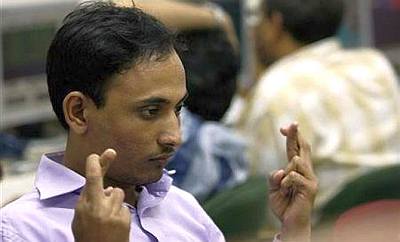
Investors remain cautious ahead of F&O expiry.

TCS, Bajaj Auto, Adani Ports and Cipla were the top gainers on BSE Sensex while Coal India, GAIL, Dr Reddy's and Infosys lost the most on the index.

Stock markets would be largely driven by macroeconomic data, auto sales numbers, FII inflows and global trends this week, analysts said. The US debt ceiling negotiations and institutional flows will also be watched by investors. "This week, market participants will closely monitor institutional flows, as there is a historical observation that when both FIIs and DIIs become net buyers simultaneously, there is a likelihood of some profit-booking in the market," said Santosh Meena, head of research, Swastika Investmart Ltd.

'New record for the Nifty50 is only a question of when.'

The improvement in the performance of actively managed mutual fund (MF) schemes is acting as a key tailwind for the nearly Rs 50 trillion industry, Kotak Institutional Equities (KIE) said in a report. The report adds that the two largest listed asset management companies (AMCs) - HDFC and Nippon India - are likely to be the biggest beneficiaries. "The industry has a solid track record of delivering alpha on 10-year returns (70-80 per cent of assets under management (AUM) beat the benchmark), with shorter duration performance also on an upswing.

The mutual fund industry's assets under management (AUM) have likely breached the Rs 50 trillion mark following a rally in domestic equities this month. The industry's average AUM stood at almost Rs 48 trillion at the end of October. In November, the Nifty50 index has gained about 4 per cent so far, while smallcap and midcap indices have rallied close to 8 per cent.

Investors' wealth fell by Rs 2.89 lakh crore in two days of market fall, with the BSE Sensex tumbling 796 points on Wednesday, amid weak global market trends ahead of the US Federal Reserve's interest rate decision. Fresh foreign fund outflows and caution ahead of a host of interest rate decisions from global central banks also added to the overall bearish trend. Besides, the US Fed meeting, the BoE (Bank of England) and the BoJ (Bank of Japan) are also scheduled to meet this week.

SBI was the biggest loser in the Sensex pack, tumbling 2.83 per cent, followed by Infosys, TCS, Bajaj Finance, Tech Mahindra, Wipro and Axis Bank. In contrast, Titan, L&T, NTPC, Power Grid, Sun Pharma, ITC and HDFC twins were among the prominent winners, rising as much as 1.97 per cent.

From the Sensex pack, State Bank of India, Axis Bank, IndusInd Bank, Tech Mahindra, HCL Technologies, Tata Consultancy Services, Maruti Suzuki, Tata Steel and Tata Motors were the major gainers. Power Grid and HDFC Bank were the laggards from the pack.

The general elections in April/May 2024 are expected to add volatility to the Indian markets, keeping investors on their toes.

M&M was the top loser in the Sensex pack, skidding 3.31 per cent, followed by Reliance Industries, Bajaj Finserv, ICICI Bank, Maruti, Tata Motors and Tech Mahindra. On the other hand, Tata Steel, L&T, Axis Bank, Bharti Airtel and HDFC Bank were among the gainers.

Nikunj Saraf, Vice President Choice Wealth, answers your queries.

In the broader market, the S&P BSE Midcap and the S&P BSE Smallcap indices gained 0.5% and 0.4%, respectively.

The number of issues were the lowest since FY15, compared to 45 in FY18.

In a memorable year for the equity market, Dalal Street investors added a whopping Rs 81.90 lakh crore to their wealth in 2023 as a raft of positive factors powered a stellar rally in stocks. Experts said India's strong macroeconomic fundamentals, political stability owing to the BJP's success in recent elections in three significant states, optimistic corporate earnings outlook, signals from the US Federal Reserve about three prospective rate cuts next year and heavy retail investors participation played a major role in fuelling the stock market rally in 2023. In the year 2023, the 30-share BSE Sensex jumped 11,399.52 points or 18.73 per cent.

An expectation of tax sops in Budget, weakness of dollar and robust tax collection are adding positive sentiment

Among the Sensex firms, Kotak Mahindra Bank, Tata Steel, ITC, ICICI Bank, Bajaj Finserv, Maruti, Mahindra & Mahindra and State Bank of India were the biggest winners. Tata Consultancy Services, Infosys, HCL Technologies, Tech Mahindra, Asian Paints, Wipro and Tata Motors were the biggest laggards.

Many investors want to exit equities now and re-enter when they begin to rise. Such timing is difficult to pull off.
'Given the inherent volatility, investors should take at least a three to five-year view.'

Rising for the second straight session, equity benchmark Sensex climbed 142 points on Thursday following buying in IT and finance stocks amid a higher opening in European markets. After a see-saw session, the 30-share BSE Sensex ended 142.43 points or 0.23 per cent higher at 60,806.22. During the day, the index witnessed a high of 60,863.63 and a low of 60,472.81.

'In the next one-and-a-half, two months you'll get decent amount of opportunities in the mid-cap and small-cap sector at lower levels.'

On the BSE, 1,650 shares declined and 1,188 shares rose

Telecom stocks fell after Mukesh Ambani extended Reliance Jio's free offers till March 2017.

Rise in crude oil price and rally in global equities aided the sentiment

Private lenders were among the top losers along with RIL.

HDFC and Infosys contribute the most to today's rally.

An allocation to ESG theme funds can bring down the overall risk of an equity portfolio. Investors with long-term financial goals, such as retirement, should not ignore sustainable investing.

Operator syndicate could be behind stock hammering, suspects regulator.

HCL Tech was the biggest loser on the Sensex chart, shedding 2.79 per cent, followed by Tata Steel, ICICI Bank, Reliance Industries, ITC, Wipro, Infosys and M&M. In contrast, Tata Motors, L&T, Bharti Airtel, HDFC Bank and SBI were among the winners, climbing up to 2.05 per cent.

Midcap stocks continued to remain on buyers' radar with BSE Midcap index up 0.1%.

Financial shares were among the top gainers with HDFC leading the gains.
Aviation companies were in focus with all the three airliners SpiceJet, InterGlobe Aviation and Jet Airways adding in the range of 2% to 3% on the BSE
Bharti Airtel was the top gainer in the Sensex pack, rising around 4 per cent, followed by Tech Mahindra, HDFC, Kotak Bank, M&M and HCL Tech. NSE Nifty advanced 21.85 points to 16,280.10.

Omkeshwar Singh, head, Rank MF, a mutual fund investment platform, answers your queries.

Markets finished the session on a dismal note with Sensex closing at its lowest level since August 2014.

After a sharp outperformance in the mid-and small-cap segments in the first half of calendar year 2023 (H1-CY23), analysts are now turning cautious on these two market segments and suggest investors stay selective and look for valuation comfort and earnings visibility before investing. The S&P BSE Midcap index has surged 13.7 per cent in H1-CY23, and the S&P BSE Small-cap index gained 12.7 per cent during this period, data shows. The S&P BSE Sensex, in comparison, has moved up 6.4 per cent.

One of the biggest advantages of index funds and ETFs is their low cost, points out Sarbajeet K Sen.
